
Action Plan
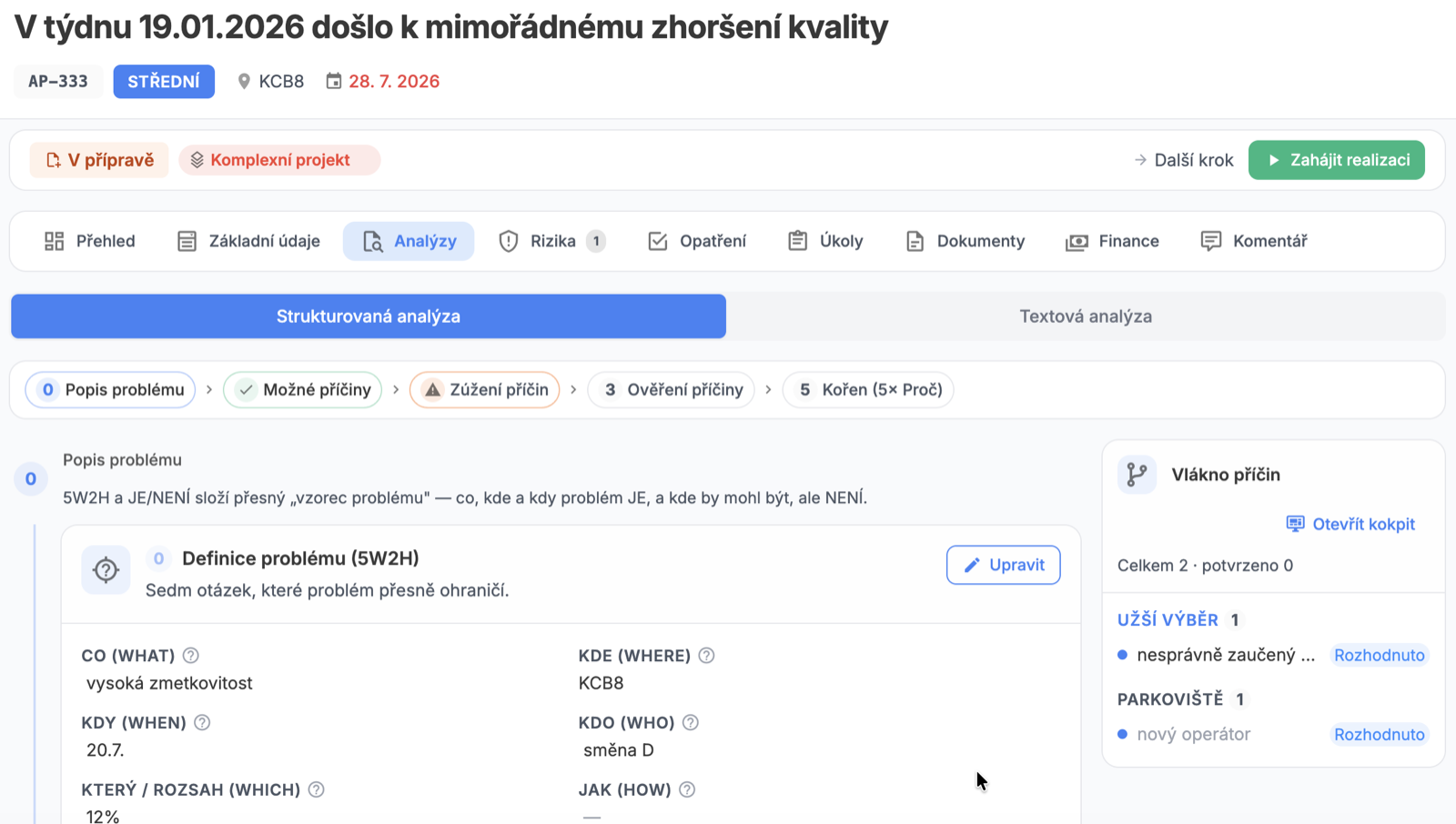
A digital action plan that adapts to the size of the problem. Enter a minor fault as an action with tasks and a completion check. For a serious problem, switch on root-cause analysis step by step - all the way to verifying effectiveness on production data. Now with an AI methodology guide that checks the solver applies the methodology correctly - and teaches them right at work.
Problems keep coming back because they are not solved systematically
Problems come back
Actions get lost
Effectiveness can't be proven
One process for everything doesn't work
The solution scales with the problem
Action Plan does not dictate one process. For each case you switch on only the steps that make sense - a small issue is not slowed down by bureaucracy, and a serious problem does not end with a superficial patch.
Quick action
minutesYou enter who does what and by when. The system watches the deadline and the confirmation it was done. No mandatory analysis.
Solution with analysis
daysBefore you start fixing, you find the real cause. The actions then target it, not the symptom.
Deep analysis
weeksThe full methodological toolkit with the AI guide. The case does not close until data confirm the problem is gone.
You can simply record a problem and delegate it first - the solver works it out step by step, and analysis phases can be added along the way. Every path ends the same, though: with a check on production data that the actions really worked. That is the closed PDCA cycle.
From analytics straight into action, in one click
Spot a recurring problem in the fault overview or analytics? One click creates an action plan with the relevant data carried over automatically - whether it is a quick action or a full project with analysis. After implementing the actions you verify their effectiveness on production data again. And while you solve, the AI methodology guide watches that you follow the methodology correctly.
Fault types
Machine location
Shift team
Scrap reason
Root-cause analysis
Actions
Tasks
Effectiveness check
AI will not solve the problem for you.
It teaches you to solve it right.
The guide does not decide, analyse or propose actions for you. It watches whether you apply the methodology correctly and, the moment you slip, puts you back on track. It only checks the phases switched on for the given case, so on a quick action it does not stand in your way. With every case you solve problems better - and they stop coming back.
The required quality control step was not performed, so cracking in the bend area and surface porosity were not detected before the pressure test.
The answer blames an unspecified person ("nobody") and does not describe a failure of a process, standard or control mechanism.
It does not decide for you
It checks the procedure
It teaches at work
You can switch the AI guide off completely - at any time
AI services not allowed in your company? No problem. The methodology guide is an optional feature: one setting switches it off for the whole plant and the action plan keeps working in full. With the guide off, no data is sent to any AI service. You can turn it back on whenever you want.
Action Plan teaches right during solving
No dedicated training time. When a solver makes a methodological mistake, the system recognises it, explains it and shows the correct procedure. Every case doubles as a lesson. People learn at the moment they need it and gradually stop repeating mistakes.
The circle becomes a spiral of improvement.
The project assigner decides which phases must be completed
A minor deviation does not need the whole chain; a recurring high-impact problem does. For each project the assigner switches on the phases the solver must complete - the three levels above are just typical setups, any combination works and phases can be added later during solving. AI guards the methodology exactly in the switched-on phases. Try the presets, or toggle the phases yourself.
5W2H
Ishikawa
Pareto, gemba, matrix
Is/Is Not, experiments
5 Whys
Action Plan
PDCA
How Action Plan spots the methodology used wrong
Under pressure most people reach for a shortcut: blame, cut corners, solve superficially. AI recognises these patterns and explains how to phrase the step correctly - process, data, root cause. The decision and the fix itself stay with you. Here are five typical interventions.
The required quality control step was not performed, so cracking in the bend area and surface porosity were not detected before the pressure test.
The answer blames an unspecified person ("nobody") and does not describe a failure of a process, standard or control mechanism. The root cause must be sought in the process, not in people.
On 3 out of 100 pieces of KC-200, cracks appear in the bend area after the pressure test. First detected on 12 June on line L2, morning shift.
The problem description already contains an assumed solution ("inspection is missing"). The definition should neutrally and measurably describe what happens, where and how often - not solve it right away.
Go through the remaining 6M categories too: Machine, Method, Material, Measurement and Environment. For cracks in the bend, mould temperature (Machine) and granulate moisture (Material) are candidates.
All causes point at people. That is a common first reflex which usually hides process and technical causes that can be removed permanently.
Add a corrective action for the root cause (adjusting the mould setup procedure) and a preventive action (mould temperature check added to the FMEA and the work instruction).
Without corrective and preventive actions only today's consequence is removed. The problem returns as soon as the immediate fix wears off.
Before closing, verify effectiveness on data: compare line L2 scrap rate fourteen days before and after implementation. Only a confirmed drop closes the case.
Implementing an action does not equal effectiveness. The Check step in PDCA confirms the problem is really gone - not just that something was done.
Every solved case doubles as a lesson
Because the system guides you methodically, you go after the real cause of the problem - not quick patches that fail in a few days and bring the problem back. People also learn right at work, so with every next case they need fewer corrections, problems stop returning and the overload drops.
AI guides step by step
The solver makes methodological mistakes and the system explains them. The case still gets solved properly, down to the root.
Fewer corrections, more confidence
The solver already knows the patterns. AI guards only the trickier steps. The process speeds up and analysis quality grows.
Works independently
The methodology is ingrained. Problems do not recur, firefighting fades and the freed-up time can go into improvement.
Every role sees exactly what it needs
Every project has an Initiator, an Owner, a Project administrator and optionally Observers. At the action level, Implementers and Effectiveness inspectors work; tasks are done by Assignees. The AI methodology guide supports everyone working on the analysis so they follow the methodology correctly.
Initiator / Administrator
The Initiator creates the project, structures the problem and assigns the Owner. The Administrator is the only one who can finally close the project.
Project owner
The main responsible person with the broadest editing rights. Runs root-cause analysis (5 Whys, Ishikawa), manages tasks and actions, assigns assignees, tracks costs and savings and evaluates impact. Moves the project through states.
Implementer
Implements the assigned action and documents the execution. Adds sub-tasks within their action. Can edit the record while the action awaits verification.
Effectiveness inspector
Verifies the effectiveness of the implemented action; confirms it or returns it for rework with a comment. The core of the PDCA cycle at the action level.
Task assignee
Responsible for completing a specific task. Sees only projects with their tasks. Starts and finishes tasks. Focused access without unnecessary noise.
Management / Observer
An overview of project status without needing to actively intervene. A monitoring and decision-making role. The department manager has full editing rights.
Frequently asked questions
A problem-solving system that adapts to the size of the problem - from a quick action with tasks and a completion check to full root-cause analysis (5 Whys, Ishikawa), three levels of measures (immediate, corrective, preventive) and verifying effectiveness on production data. It closes the PDCA cycle.
Yes. For a minor fault you enter just the action, tasks and a completion check - no mandatory analysis. It takes a few minutes and the system watches the deadline and the confirmation. You switch on root-cause analysis only for problems that deserve it.
No. For each case the project assigner sets which phases (5W2H, Ishikawa, Pareto, Is/Is Not, 5 Whys, actions, PDCA) the solver must complete, and phases can be added later during solving. A minor deviation does not need the whole chain; a recurring high-impact problem does.
No. AI does not decide, analyse or propose actions for you. It only checks that you apply the methodology correctly and, when you make a mistake, points it out and explains it. The content of the solution and the final decision stay with people.
Yes, at any time and completely - with one setting for the whole plant. The guide is an optional feature; if your company does not allow AI services, the action plan works in full without it and no data is sent to any AI service.
From reported faults and problems, from TPM Analytics, Gemba walks, meetings and audits. Instead of getting lost in inboxes and heads, they live in one place with an owner and a deadline.
Every measure has an owner and a deadline. Overdue items escalate to the supervisor. Management sees the status of all measures in a single overview.
Yes. You can start with just the action plan and add AMS, TPM, Production Management and Analytics over time. The biggest benefit, though, comes from connecting them - that is when the whole PDCA cycle closes.
Stop solving problems in spreadsheets
kamil.vasak@idomino.cz · +420 724 135 735