
Company memory that doesn't leave with people
Your best process engineers are in the heads of people who may have left long ago. From your records, solved cases and closed findings we build a memory the whole plant can rely on. Best Practices works as a virtual senior process engineer you always have on hand.
Works exclusively on your history and data
Organizational amnesia costs shifts
- An operator reports a defect and looks for the solution in the head of the nearest senior.
- When the senior is on vacation, the problem waits.
- When they retire, the know-how leaves with them.
- SOPs, audit records and historical solutions exist, but nobody has time to search them.
- The same defect is solved three times a year, a different operator each time, each time from scratch.
The cost: repeated searching means lost shifts, inconsistent procedures between lines, a new process engineer has nowhere to gain experience, and at an audit you can't explain why you solved it that way.
Five steps from question to a verified solution
Morning shift, a recurring defect
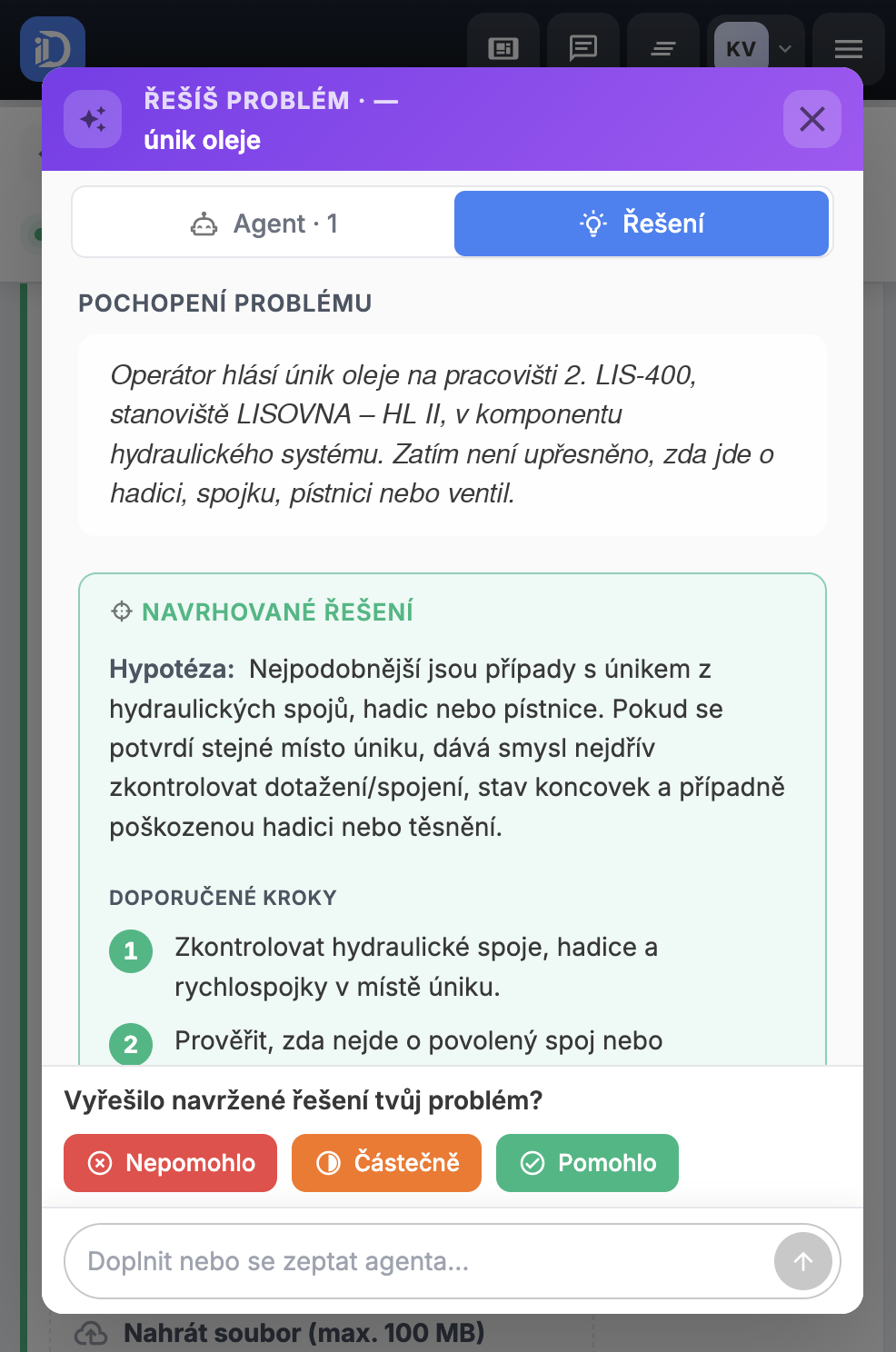
The operator reports an oil leak at workstation 2. LIS-400, station LISOVNA - HL II, in a hydraulic system component. It is not yet specified whether it is a hose, a coupling, the piston rod or a valve.
- 2026-02-18 (LIS-250) · solved by M. Dvořák. Cause: a loose quick coupling on the pressure branch. Result: retightened and the fitting replaced, leak stopped.
- 2025-09-30 (LIS-400) · similar defect. Cause: a chafed hydraulic hose near the piston rod. SOP: visual hose inspection during weekly maintenance.
Hypothesis: the closest matches are leaks from hydraulic joints, hoses or the piston rod. If the same leak point is confirmed, it makes sense to first check the tightening of the joints, the condition of the fittings and possibly a damaged hose or seal.
- Check the hydraulic joints, hoses and quick couplings at the leak point.
- Verify whether it is a loose joint or a damaged seal.
- If wear is confirmed, replace the hose or fitting and write the result back into Best Practices.
New process engineer, unfamiliar production
A junior started a month ago, the senior left. Instead of fumbling, they ask the module and get a data-backed proposal with links to historical cases. They learn faster and make fewer mistakes.
Audit and compliance
“Why did you solve the defect that way?” Instead of “because Pepa told us” you have a documented chain in the system: problem → proposals → approver → implementation → result.
Do ✓ and don't ✗
What the AI does NOT do
Just as important as what the module can do is what it must not. Without these safeguards, the assistant would become a risk.
What the module draws on
Technical prerequisite: a deployed iDomino platform with a populated knowledge base and a defined Best Practices workflow. The module improves as the database grows, so you can fill it gradually. Optionally a local AI model for customers with strict data-residency requirements.
What we're asked most often
The module starts working from the first closed Best Practice. Value grows with data volume, but even the first 50 cases make a noticeable difference.
Yes. A Best Practice from one plant can help another if you allow that visibility - with automatic translation into each user's native language when you also use the Live data translation module. The default is separation of data between individual customers and plants.
The module understands short, informal descriptions. You don't have to address it as “Dear assistant”. A few words are enough.
Technically days. Realistically it depends on the state of your knowledge base. We help structure it.
The Best Practices workflow connects to your existing task and action-plan system. Commitments and deadlines go into your existing environment; we don't create a parallel store.
Want to see the module in action?
In 60 minutes we'll show you how the module finds a similar case from history and how it becomes company memory.
Book a presentation